




|
|
Article: Set
in Steel: Prison Life Without Parole; from Truthout.org
(US), 11/28/07
Petition for Federal Parole -- How you can help
Read and Sign Online Petition
-- Download Petition
(pdf) -- Petición En línea
De la Muestra
Action Alert: The Criminal Justice Tax Relief Act of 2008
(CJTRA) "A bill to establish a hybrid system of parole for
federal prisoners"; draft of a proposed parole bill from
FedCURE,
May 2008
In the spring of 2002, the November Coalition presented and
began organizing around a simple demand for a return to parole
or increase in good time for federal prisoners. Called, The Petition
for Relief from Drug War Injustice, our membership is convinced
that we need relief -- something that would reduce the harm of
present long, mandatory sentences.
At the same time we adamantly have encouraged proposals that
include the nonviolent person serving life without parole; and
that rehabilitation and reentry programs be available to all
prisoners regardless of race and class. The petition, a simple
vehicle to ensure legislation returning systems of early release
to federal prisoners, gives our members opportunities to discuss
the dismal failure of the war on drugs and the stark realities
of a policy that makes a problem worse, instead of making people
safer.
By mid-summer of 2002 Representative Patsy Mink (D-HI) had
introduced a bill to revive parole. A few short weeks later,
the honorable Patsy Mink had passed away due to complications
from chicken pox. Since her death the bill has returned to Congress,
with different Bill Numbers, but the same intent -- to give federal
prisoners a way to earn an early release. The current Congress,
the 110th has not yet seen a bill to create earned, early release,
or a return to parole.
Share the Petition for Relief successfully
within your circle of friends, neighbors and your entire community.
Download the Petition
(.pdf), and ask others to help gather signatures of support
for significant increase in "good time" eligibility
and/or a return to federal parole. Add this website page address
to your e-mails, with request for people to sign on to returning
federal parole, and become a member
of the November Coalition today.
The Petition for Relief from Drug War Injustice
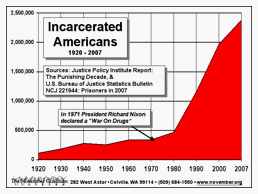
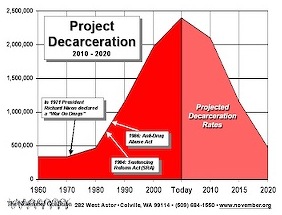
In the mid 1980s Congress abolished parole and passed harsh
drug sentencing laws. Many states followed, creating a tenfold
increase in the number of drug offenders incarcerated. We have
lost cherished legal traditions and endured many other unintended
consequences due to a destructive, anti-drug policy.
It is illogical to spend tax dollars on long imprisonment
when other means have proved far more effective in addressing
the social problems of drug abuse and addiction. State leaders
across the U.S. are reforming sentencing guideline, drug and
parole policies. We urge federal leaders to do the same: Provide
prisoners with an incentive to maintain exemplary behavior in
prison and earn early release.
Earned, early release would foster incentives toward cooperation,
study, and learning skills that would create a safer environment
for staff and prisoners alike. Families could be reunited earlier,
with better prospects for successful reentry into society. High
costs of incarcerating drug offenders -- $9.4 billion annually
-- would be dramatically reduced. Inhumane prison overcrowding
would be relieved, the federal system is 31% over capacity, and
growing more than 9% annually.
We, the undersigned, support the November Coalition's demand
for relief from drug war injustice through a revival of federal
parole and/or a dramatic increase in "good-time" eligibility
of prisoners in federal custody.
|
Petition title
Learning to be active with others can
be something else you may consider as you wrestle with how to
return a system of release to federal prisoners. Bottoms
Up: Guide to Grassroots Activism, a comprehensive, step-by-step
primer in how to educate the public and get the social change
you want. Useful for both beginning activists and seasoned organizers,
this how-to manual covers topics such as Organizing a Public
Event , Teaching with a Table, Private Meeting
with Officials, Designing Flyers and Posters, Working
with Others, Leading a Demonstration, progressing to Building
a Relationship with the Media and Elected Officials. Also
included is a generous sampling of artwork, press release examples,
educational literature, studies and reports, graphs and displays
to share with the public, meeting forms, and other resources
for organizers of different levels of skill.
Talking Points
Convince the curious, perhaps unknowing, doubtful or hostile
listeners about the need for real change in US drug and sentencing
laws. Remember, in almost any group of people, there will be
one or two individuals who will be certain to challenge what
you say. For these people, you prepare by visiting Talking
Points
More about Federal Parole
We have posted for public review prisoner written and inspired
proposals dating 1993 to present., and past & current Congressional
Bills of particular interest. Also study the History of US Parole
as written by the United States Parole Commission, and learn
more about recent legislation that affects federal prisoners
by laying groundwork for future early release plans. Write letters
about returning parole and good time; we will post them in recent
media stories. Lets get this issue in the news! For more information,
read More about Federal Parole:
look over Citizen Proposals, and see Current Congressional Bills
here.
More about Federal Guideline Sentencing
To better understand the sentencing system prior to Congressional
changes in the mid-eighties and why the current sentencing and
enforcement system needs reform, visit More
about Guideline Sentencing
The US Sentencing Commission's Assessment of How Well the
Federal Criminal Justice System is Achieving the Goals of Sentencing
Reform warrants study. You
can view the Executive Summary and download the report here.
There is at present NO bill in the U.S. Congress 110th session
to restore federal parole. For reference only, we include information
about the parole bill from the last Congress, introduced in 2005
(now inactive).
For current information on ALL bills from the current and
past Congressional sessions, visit the Thomas Legislative Pages
of the Library of Congress at: http://thomas.loc.gov/
HR 3072: To Revive The System Of Parole For Federal Prisoners
(Introduced 6/27/05, 109th CONGRESS; 1st Session)
Co-Sponsored by Rep Clay, Wm. Lacy [MO-1] - 9/29/2005;
Rep Conyers, John, Jr. [MI-14] - 9/21/2005; Rep Rangel, Charles
B. [NY-15] - 9/21/2005; Rep Jackson, Jesse L., Jr. [IL-2] - 12/7/2005,
Rep Lewis, John [GA-5] - 12/7/2005; Rep Thompson, Bennie G. [MS-2]
- 12/8/2005; Rep Jackson-Lee, Sheila [TX-18] - 12/8/2005; Rep
Moore, Gwen [WI-4] - 12/14/2005; Rep Owens, Major R. [NY-11]
- 2/8/2006; Rep McKinney, Cynthia A. [GA-4] - 2/8/2006; Rep Schakowsky,
Janice D. [IL-9] - 3/1/2006, Rep Serrano, Jose E. [NY-16] - 5/9/2006
Supporting a Return of Federal Parole:
How You Can Help!
(HR 3072 Full Bill Text
Available Here.)
The U.S. House of Representatives' Judiciary
Committee has received a parole bill for review and action.
Introduced on June 27th, 2005 by Rep. Danny Davis (D-IL), HR
3072 is long-awaited legislation To Revive The System Of Parole
For Federal Prisoners.
We want the Judiciary Committee to know there is already significant
public support for the bill, and we can present that today. More
than 101,000 people have signed our Petition
for Relief, evidence of substantial, growing public approval
for earned, early release principles. Please sign, if you haven't
done so: http://www.november.org/parole/sign.html
Judiciary Committee members will
initially be calculating potential House of Representative's
support for HR 3072, and, as of today, there are no co-sponsors.
A bill is certain to be tabled early (which kills the bill) unless
there is show of public and congressional solidarity demanding
action. It is the hard work of people like you, your ability
to communicate, that causes a proposed bill to move forward through
the legislative process.
It's time to TAKE ACTION NOW. Send a letter to your
U.S. Representative asking her or him to co-sponsor HR 3072.
To do this quickly, copy the sample letter below into a traditional
letter and mail it. To find your legislator and email the letter
with ease, go to www.vote-smart.org,
and enter your zip code. All contact information will pop up
on the screen.
While at Vote
Smart, you can copy the message, edit it into your own words,
and email it to your Representative. The mailing address is convenient
to use, but don't forget, first, to prepare your message to be
mailed. A sample letter is below.
Wait a week, and then call your Representative's office. A
receptionist will answer, and to this person, say that a constituent
is calling to urge Representative ____ to support an important
bill. At that time, you will be connected to a legislative aide,
your member of Congress (though unlikely), or an answering machine.
We've provided a sample telephone message below, too. Feel free
to leave it on an answering machine, if that is all you get to
talk to.
People who hold elected positions in government actually do
notice, count and use citizen communications. Remember, your
call is meant to bolster and encourage your member of Congress
to support a return to parole. Politeness always works better
than an angry rant. Try not to argue if you get a live voice.
If speaking to an answering machine, the best move may be to
carefully read the sample text message below. End with a warm
'thank you;' ask for a response, and you're done.
If your elected representative is a member of the Judiciary
Committee, your personal contact with s/he carries increased
importance, and we want to hear from any November Coalition members
who live in the districts of Judiciary Committee members. Please
email nora@november.org
if you are one of those people. We've included the list of Judiciary
members below as well.
Save this post, and share it with your family and friends.
Sample Letter to your United States Representative:
Dear Honorable __________:
I am writing to ask you to co-sponsor HR 3072, a bill To Revive
The System Of Parole For Federal Prisoners. The bill makes fiscal,
social and moral sense.
Most of the prisoners in federal custody are non-violent drug
offenders. It is illogical to spend tax dollars on long imprisonment
when other means have proven far more effective in solving the
social problems of drug abuse and addiction. State leaders across
the U.S. are moving ahead on their own to reform failed sentencing,
drug, and parole policies.
Enactment of HR 3072 would provide prisoners with an incentive
to maintain exemplary behavior in prison. A humane philosophy
of earned, early release would foster incentives toward cooperation,
study, and learning skills that would begin creating a safer
environment for staff and prisoners alike, not to mention a more
successful re-entry.
With hope for the future, and families reuniting earlier,
the impact and social costs of incarceration would be lessened.
High costs of imprisonment -- more than $10 billion annually
for nonviolent drug offenders alone- could be dramatically reduced.
Inhumane prison overcrowding would be relieved, along with the
immediate need to build expensive, additional prisons.
Please co-sponsor HR 3072 to build a safer society by promoting
rehabilitation, shorter incarceration times for deserving prisoners,
and more appropriate use of public funds to strengthen effective
social programs.
Sincerely,
(Your name and complete contact information)
Sample Telephone Call
Hello, my name is (First and Last name), and I am a constituent
living in (city). I'm calling to urge you to support HR 3072,
a bill to revive Federal Parole. Most of the prisoners in federal
custody are non-violent drug offenders. It doesn't make economic
sense to spend tax dollars on long imprisonment when cheaper
means have proved far more effective in solving the social and
public health problems of drug abuse and addiction.
Please co-sponsor HR 3072 to build a safer society by promoting
rehabilitation, shorter incarceration times for deserving prisoners,
and more appropriate use of public funds for cost-effective social
programs. My phone number is (_______). Thank you.
For current information on ALL bills from the current and
past Congressional sessions, visit the Thomas Legislative Pages
of the Library of Congress at: http://thomas.loc.gov/
|