 October
1, 2007 - Daily Pilot (CA) October
1, 2007 - Daily Pilot (CA)
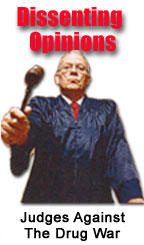
OpEd: It's A Gray Area: Current Drug Policies Inefficient
By James P. Gray, Orange County Superior Court judge
Let us face facts and let us not mince words: Our nation's
policy of drug prohibition is not working.
This policy is actually causing much more harm than the prohibited
drugs themselves would ever be causing on their own -- here and
everywhere else around the world.
And the irony is that we could literally bulldoze the entire
country of Colombia, even taking Ecuador and Peru with it, and
that would not make the slightest difference with our drug problems
in our country.
Why?
Because if the demand is here, the demand will be met. And
if the demand is not met by drugs from Colombia, Ecuador or Peru,
it will be met by drugs from Afghanistan, Nigeria or Thailand.
Or even here in California!
Today, marijuana is the No. 1 crop in California (number two
is grapes, if you care). In other words, we have failed to repeal
the law of supply and demand, and amazingly enough continue to
express surprise at that result. And what is worse, we do not
even let ourselves discuss the subject!
In normal life if something does not work, we recognize that
reality, explore our options and try something different.
But even though virtually no one will say that our war on
drugs is working, we continue to spend ever more money and other
resources on something that has been proven not to work. "If
spending lots of money didn't work, we'll just have to spend
much more" seems to be the philosophy.
The evidence of the failure of the war on drugs is all around
us. Today, illicit drugs almost literally could not be made more
available if we tried.
Look at it this way: People in prison can get all of the drugs
they want. It costs more money, but they are fully available.
For example, Charles Manson was transferred from Corcoran
State Prison in California to a different facility a few years
ago because he was found to be selling drugs from his prison
cell. And he was in solitary confinement!
So if we cannot keep drugs out of our prisons, what makes
us think that we can keep them off the streets of any of our
towns or cities?
Every day in our nation's newspapers there are articles about
violent deaths being caused not by drugs, but by drug money.
With great fanfare we destroyed the Medellin Cartel. But did
it make any difference? No, within just a few months the Cali
Cartel was up and running. Now we have destroyed the Cali Cartel.
Has it made any difference? Again the answer is no. Illicit drugs
are just as big and successful a business as ever.
As an example, just a few years ago the head of the United
States Drug Enforcement Administration was quoted as saying that
at any one time about 200 tons of cocaine are being warehoused
in Mexico within three miles of the U.S. border just waiting
to be smuggled into our country to any place where there happens
to be a shortage.
In addition, even though our government has spent about $470
billion on "Plan Colombia" with our military actions
and spraying of herbicides in rural areas, the cost of Colombian
cocaine in our country today is only about one-third of what
is was in the 1980s. Of course, we are also seeing the same results
in Afghanistan with heroin. And in case you have not noticed,
violence if not actual warfare caused by drug money has broken
out in Mexico along our border, and has literally spilled over
the border into the southwest United States.
Even when the police are successful in seizing a large quantity
of drugs, that only temporarily reduces the supply, which increases
the price of the drugs and in turn increases the incentives for
people to sell them. The end result of this economic reality
is that the policy of drug prohibition is doomed to failure,
which means that "victory" increasingly is simply being
defined as slowing down the pace of defeat.
When I discuss this issue publicly, the biggest argument I
hear in favor of maintaining our policy of drug prohibition,
"with all of its defects," is that changing it would
"send the wrong message to our children."
So what about our children?
Actually, our policy of drug prohibition is literally putting
our children in harm's way for each of two deeply disturbing
reasons. Firstly, it is easier today for children to obtain any
illicit drug, if they want to, than it is alcohol. Why? Because
illicit drug dealers make money by furnishing it to them.
You might say that no one wants teenage children to become
addicted to cocaine, but some people make a great deal of money
if that happens.
As a result, lots of drug dealers offer free samples of illicit
drugs to our children, even on their school campuses. Of course,
that does not happen with regard to other sometimes dangerous
and addicting drugs like alcohol and tobacco.
Why?
Because when we make drugs illegal, we give up all of our
ability to regulate and control them. That means that by default
the strength, quantities and purity levels of the drugs that
are being sold and the age restrictions for the buyers are exclusively
controlled by the illicit drug dealers, and they don't ask for
ID.
Secondly, and I saw this happen continually when I was a federal
prosecutor, and later when I was presiding over a juvenile court
calendar, every day adult drug sellers recruit our children to
help them in their scurrilous business.
For a relatively small amount of money and the threat of violence,
adult drug dealers can have all the young people they want to
use as "go-fers," lookouts and couriers, etc.
And then just as night follows day, as soon as the reliability
of the young people has been established, the adults trust them
to sell small amounts of drugs in their communities.
They do this so that the youngsters make more money, and so
do the adults. So then ask yourself this question: When teenagers
sell drugs in their communities, to whom do they sell? Us? No,
they will naturally sell to their teenage peers, thus recruiting
more and more young people to a lifestyle of drug usage and drug
selling. It is not a pretty sight, and it is all directly caused
by our failed and hopeless policy of Drug Prohibition.
Yes, once we finally came to our senses and repealed alcohol
prohibition we were still left with problems of alcohol misuse,
abuse and addiction. But at least we were no longer plagued with
the Al Capones and their violence and corruption, as well as
the medical problems presented by the lack of quality control
for the "bathtub gin."
What should be our plan instead? In my view, we should resume
using the criminal justice system in the way it was designed:
to hold people accountable for what they do, instead of what
they put into their bodies. Along those lines, it makes as much
sense to me to put that gifted actor Robert Downey, Jr. in jail
for his cocaine addiction, and he certainly seems to have one,
as it would to have put Betty Ford in jail for her alcohol addiction.
It is the same thing; it is a medical problem. But if Robert
Downey, Jr., Betty Ford or you or I drive a motor vehicle while
under the influence of any of these mind-altering drugs, that
will still be an offense. Why is that? Because now those people
would by their actions be putting the safety of other people
at risk. When we finally are able to make that distinction in
our approach, we will begin to make real progress in this area.
So what action should we take now? The first thing to do is
for our president to appoint a blue-ribbon commission to investigate
the possibility of change -- as publicly as possible. Then in
my view the first substantive action we should take is to treat
marijuana like alcohol. What would happen if we were to do that?
Three things, and all of them positive. Firstly, we taxpayers
in California would literally save about a billion dollars every
year that we now spend in a futile effort to eradicate marijuana,
and to prosecute and incarcerate non-violent marijuana users.
Secondly, we could tax the stuff, and raise about $1.5 billion
every year for the state coffers. So those two things alone would
change the budget deficit in California by about $2.5 billion
every year. And that is money that we should use for drug education
and drug treatment, which will result in decreased problem usage
of all drugs. But the third thing would be more important than
the first two combined, because this we would be making marijuana
less available for our children than it is today, as we have
already discussed.
So what is not to like?
Eighteenth-century English jurist William Blackstone said
that "The law is the embodiment of the moral sentiment of
the people," and I certainly agree with him.
But just because we change our approach to this serious problem
does not at all mean we condone drug abuse, and our children
will understand that concept. There are better ways of accomplishing
our goals of reducing drug abuse and all of the crime, misery
and corruption that accompany it. In fact, we will discuss some
of the programs that are actually working in other countries
around the world in this column next week. So stay tuned.
In the meantime, let us take off our muzzles, and give ourselves
permission to discuss the subject of drug policy openly, fully
and honestly. We have nowhere to go but forward.
James P. Gray is an Orange County Superior Court judge
and author of the book, "Why Our Drug Laws Have Failed and What We Can
Do About It -- A Judicial Indictment Of The War On Drugs."
Back to Dissenting Opinions
of Judges
If you have a Dissenting Opinion of a Federal or State Judge,
please mail or e-mail a copy to:
November Coalition
282 West Astor
Colville, WA 99114
(509) 684-1550
editor@november.org
|